Starship Build Engineering System
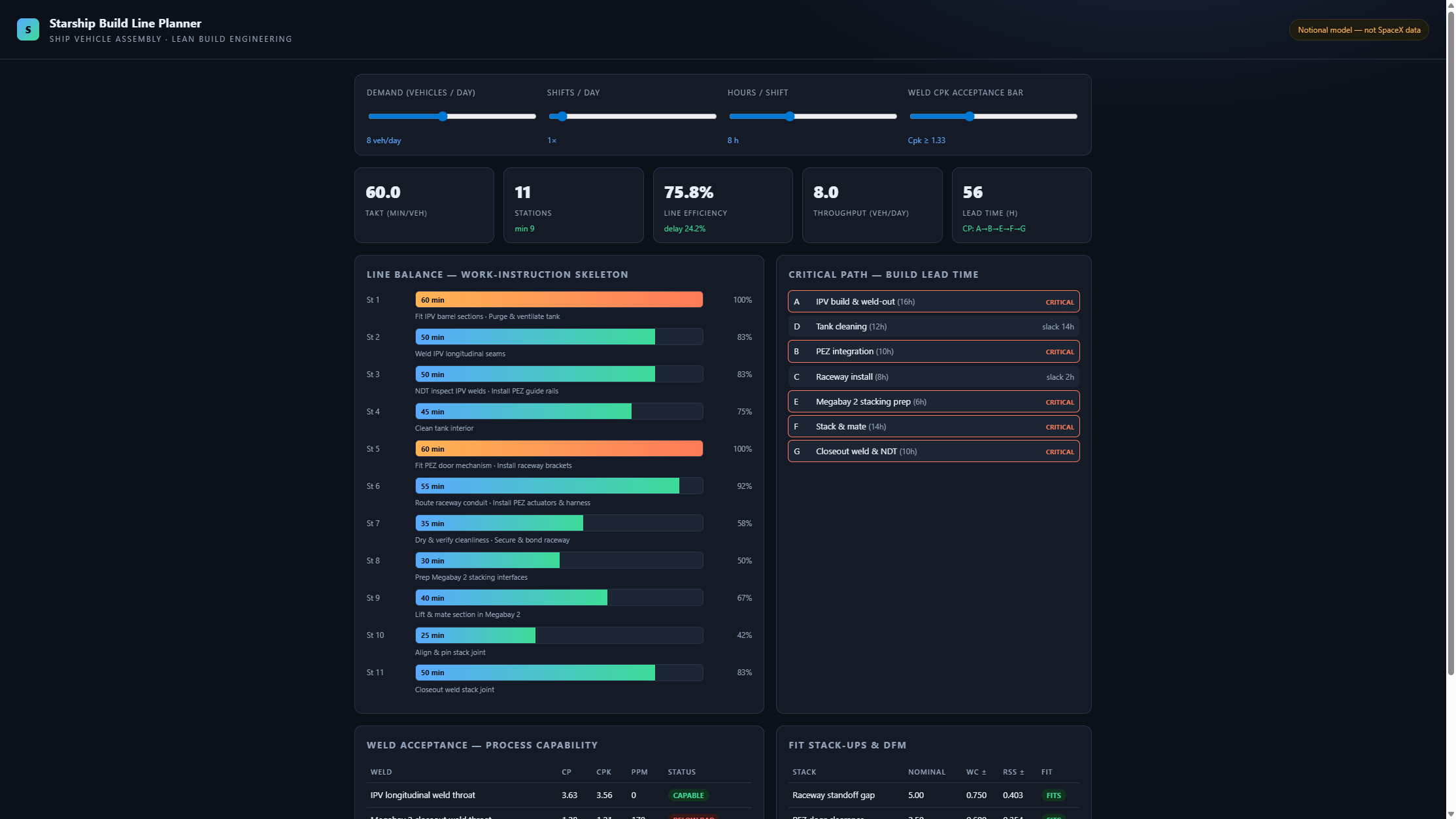
A lean build-engineering decision system for Starship Ship vehicle assembly — takt-driven line balancing, critical-path lead time, weld process capability, tolerance stack-up, and DFM consolidation across IPV, PEZ, Raceway, Tank Cleaning, and Megabay 2 Stacking. Dependency-free, with a disclosed notional-data seam.
At a glance
Five engines
Takt & line balancing
Ranked-Positional-Weight balancing into takt-bounded workstations — line efficiency, bottleneck, throughput, and parallel-station sizing for high-rate production.
Critical-path scheduling
Full CPM forward/backward pass — earliest/latest start & finish, slack, and the zero-slack path that sets the vehicle's build lead time.
Process capability
Cp, Cpk, expected PPM and sigma level for weld / dimensional acceptance against print limits — the rate-production quality gate.
Tolerance & DFM
1-D worst-case + RSS stack-up for assembly fit, and Boothroyd-style DFM scoring with part-count and assembly-time reduction.
Screenshot
Deliverables
Overview
What it is and how to run it
Outcome Contract
Scope, role mapping, honest constraints
Verification Report
18/18 checks + benchmark
Benchmark Report
Line-balancing vs naive baseline
Proof Report
Certification state, grade, trust score
Executive Evidence
Answers the 10 IRS_AUDITOR questions
Limitations
Seams, assumptions, scope boundaries
Auditor Objections
Hostile objections + evidence responses
Auditor Challenge
Per-claim hostile interrogation
Evidence Grade
Grade basis + scale
Reproduce
Exact commands to reproduce every number
Verify
How verification runs + what each check asserts
User Guide
CLI, planner, and how to use it
Run & Deploy
Local run + plugging in real data
Release Notes
v1.0.0 summary
Honest scope
The Starship build model (operations, times, weld samples, tolerances, part counts) is notional, self-authored engineering data — not SpaceX proprietary data or measured production figures, and no hardware was built. What is verified is that the engineering math is correct and reproducible: 18 / 18 hand-checkable checks pass, and the line-balancing benchmark lifts efficiency by 45% and removes 31% of stations vs a naive baseline on that model. The Proof Layer assigned state CERTIFIED, Evidence Grade B, Trust 80/100. See the proof report and limitations.
Delivery metrics
Tokens, elapsed time, and cost for producing this outcome. Basis: Estimated — reproducible model over this outcome’s published artifacts. metrics.json
Cost and tokens are estimates derived deterministically from published artifacts and representative list pricing; actual billing may differ. Model basis: claude-sonnet-class (representative).